Our offices will be closed on December 25th and January 1st. We will resume normal business hours on the following day. Thank you for your understanding.
All of us strive to have the perfect smile. A fresh smile instantly boots our self-confidence and makes us feel on top of the world. Maybe we are diligent about brushing and flossing twice daily, avoiding soda, wine, and other things that ruin our teeth. Unfortunately, healthy dental care habits may not be enough. In order to achieve the perfect smile, we need to realize the importance of regular teeth cleaning. There are countless of benefits of regular teeth cleanings. Read on to learn 4 reasons why regular teeth cleanings are a must.
To prevent gum disease. Typically caused by poor brushing and flossing habits, gum disease is swollen, bleeding gums. Gum disease can lead to the loss of teeth if not taken care of immediately. Regular dental checkups will help to prevent this.
To have that bright and perfect smile. Your daily routine may cause your teeth some unintentional harm. Regular dental cleanings are a vital way to shine up your pearly whites.
Prevents bad breath. The buildup of tartar and plaque on your teeth can lead to bad breath. No amount of breath mints will permanently cause you to have fresh breath. Frequent cleanings will ensure you no more bad breath.
Helps to detect dental problems early. Regular teeth cleanings will help you save countless on money and future pain. Allow your dentist the time to detect problems such as cavities and gum disease early.
Dental Care Near You
To maintain general health and avoid symptoms of dental complications, be diligent about scheduling regular dental cleanings for yourself and your family. We recommend a cleaning every six months to ensure a healthy, fresh smile. Don’t waste another day feeling self-conscious over your smile. Call Family Dental Care™ today to schedule your next appointment!
A healthy smile is the first step to a healthy body. That includes your gums and jaw bone. Your jaw bone is an essential part of keeping your gums and teeth stable and healthy. At times, people require a jaw bone graft. Bone grafting reconstructs the jaw bone and is vital for your teeth. When…
The Smile Checklist is courtesy of Family Dental Care™ in Oak Lawn and Evergreen Park, IL. This is endorsed by the American Dental Association (ADA).
Look in the mirror.
Do you like the way your teeth look?
Do you dislike the color of any of your teeth?
Are there spaces between your teeth?
Do you have any chips or cracks on your teeth?
Are you missing any teeth?
Do you have any crooked teeth?
Do you feel your teeth are too long or too short?
Are you pleased with the shapes and position of your teeth?
If your answers show that you might want a change in your smile, talk to your dentist about Improving Your Smile. You can request an appointment on-line at Family Dental Care™ by visiting their website at www.FamilyDentalCare.com and choosing a dental office nearest you.
A great smile can be the most attractive feature of your face. A smile helps you express health, success, youth and sincerity. It is a great asset in your personal, business and social contacts. So it’s important that you are happy with how your smile looks. But if you are like many people, you may not be.
Your dentist has many different techniques to shape, sculpt, and make your smile more beautiful. With a few simple steps, you can have a smile you feel great about. And treatment may be more affordable than you think.
Example of an Improved Smile
Options for improving your smile include:
Tooth-Colored Fillings
Your dentist can use natural-colored materials to restore teeth that have cavities. Options include composite materials, such as resin, as well as lab-made porcelain inlays, inlays and crowns.
Tooth Whitening
Teeth become stained for many reasons – drinking coffee, tea or wine; smoking; and even aging can discolor teeth. Tooth whitening is a process that makes discolored teeth whiter. The bleach used for in-office (chair side) whitening is stronger than the bleach found in at-home whitening kits. Keep in mind that not everyone’s teeth can become movie-star white. Your dentist can recommend the whitening treatment that is right for you.
Veneers
Veneers are thin, tooth-colored shells that are bonded, or cemented, to the front of your teeth. They are custom-made of ceramic or composite resin, and look like natural teeth. Veneers can be used to fill spaces between teeth and to cover teeth that are stained, poorly shaped, or a bit crooked.
Braces
Braces can help correct crowded or crooked teeth or an uneven bite. Braces have become much smaller and less noticeable over the years. Brackets, the part of the braces that attach to each tooth, can sometimes be attached to the back of the tooth to make them less noticeable. Some brackets are clear or tooth coloured-which help braces blend in.
In some cases, treatment may be done without using braces at all. A series of clear, removable aligners are used to move your teeth over time. These aligners are more discreet than traditional braces.
Enamel Shaping
Your dentist can “reshape” your teeth by contouring tooth enamel, the outer layer of the tooth. When teeth are a little crowded or uneven, or when teeth appear too long, your dentist can use enamel shaping to improve how the teeth look.
Crowns
If a tooth needs more a dramatic change than veneers or enamel shaping can provide, crowns are an option. The outer part of the tooth is removed and a crown is placed over it. The crown can be made to fit in with your other teeth. It’s like a fresh start for your tooth.
First Steps to a New Smile
Once you decide to improve your smile, the first step is to visit your dentist. At this visit, you will talk about the best plan for you. If you have any signs of dental disease, your dentist may recommend treatment for this. It’s important to have a healthy mouth before starting cosmetic treatment.
These treatments and others can help you have more natural-looking and attractive teeth. What are you waiting for? Call Family Dental Care™ today about how to make your smile the best it can be. For Evergreen Park residents call (708) 425-1134 and for Oak Lawn residents call (708) 425-9101.
All of us strive to have the perfect smile. A fresh smile instantly boots our self-confidence and makes us feel on top of the world. Maybe we are diligent about brushing and flossing twice daily, avoiding soda, wine, and other things that ruin our teeth. Unfortunately, healthy dental care habits may not be enough. In…
(South Chicago, IL) The Academy of General Dentistry (AGD) honored Alexander G. Alemis, DDS, FAGD with this prestigious honor during the AGD 2015 annual meeting in San Francisco, CA. The AGD Fellowship Award is presented to dentists who complete more than 500 hours of dental continuing education and pass a comprehensive written exam.
Approximately only 5% of General Dentists in the country get to receive this award.
Award-Winning Dentist Near You
Dr. Alexander Alemis and Family Dental Care™ have been serving the South Chicago community for over 30 years, helping thousands of families maintain healthy teeth and gums. “We make smiles,” stated Dr. Alemis, who is also a published author and international speaker.
Family Dental Care™ is devoted to providing the highest quality care and oral health education to our patients. We offer general and specialized dental services in all aspects of dentistry.
With our fifth practice now open in Oak Lawn, we offer even more expanded hours including weekends and evenings. Our locations include: 3009 E. 92nd Street (Chicago, IL), 10601 S. Avenue E (Chicago, IL), 313 E. River Oaks Drive (Calumet City, IL), 2803 W. 95th Street (Evergreen Park, IL) and the new office listed above is at 9101 S. Cicero Avenue (Oak Lawn, IL).
For more information and to see over 1,800 patient reviews, videos and testimonials, please visit our website: www.FamilyDentalCare.com
The Smile Checklist is courtesy of Family Dental Care™ in Oak Lawn and Evergreen Park, IL. This is endorsed by the American Dental Association (ADA). Look in the mirror. Do you like the way your teeth look? Do you dislike the color of any of your teeth? Are there spaces between your teeth? Do you…
Chicago, IL – August 31, 2015 – The condition you may refer to as “gum disease” is also called periodontal disease. The American Dental Association defines periodontal disease as the inflammation of the gums that if severe, can led to the loss of the tissue that hold your teeth in place. Periodontal disease if the number one cause of tooth loss. According to the U.S. Surgeon General, this condition affects eighty-five percent of American adults age 18 and older.
Family Dental Care™ is excited to announce the offering of a safe, effective and comfortable in office treatment for periodontal disease, LANAP or laser assisted new attachment procedure.
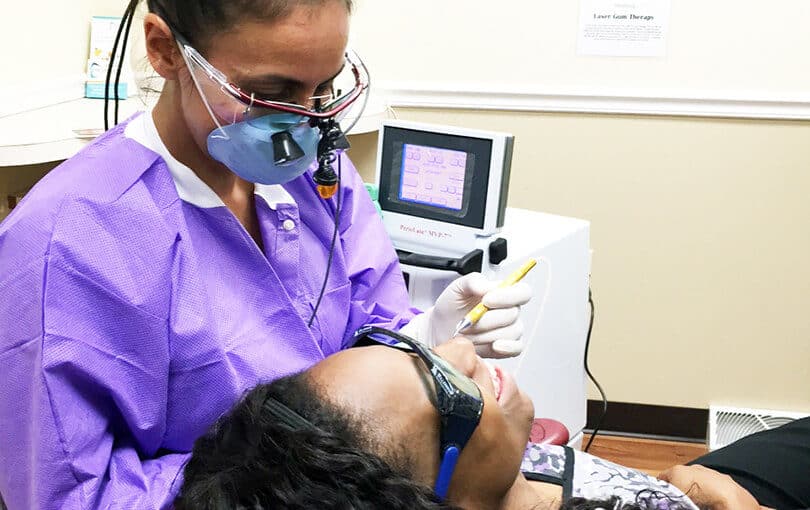
LANAP is an FDA-approved full mouth protocol used to treat periodontal disease. Under local anesthesia in the office, a tiny laser fiber is inserted between the tooth and gum to remove diseased tissue. The tooth roots are then thoroughly cleaned of tartar and plaque. A fibrin clot is then created by the laser to seal the pocket. This allows for the regeneration of the tissues destroyed by periodontal disease.
Laser Treatment Near You
Before LANAP, patients with periodontal disease typically underwent scalpel and suture periodontal surgery, an invasive tissue-removing procedure, which causes sensitivity, root exposure, and an increase risk of root caries. In addition, recovery can take weeks.
LANAP does not cut or remove tissue. No sutures are placed. Therefore, the procedure is less painful, less invasive, and a much shorter recovery period. Most importantly, LANAP provides regeneration of lost tooth support which traditional gum surgery cannot.
“By reducing post-operative pain and recovery time, LANAP eliminates many of the reasons that so many patients hesitate to seek treatment for periodontal disease and helps me ensure that they get the best possible dental care,” said Dr. Alexander Alemis, D.D.S., FAGD.
There are many different types of lasers used in dentistry today, and NOT all lasers are created equal. LANAP is a strict protocol with very beneficial outcomes.
All dentists who perform LANAP are required to complete a comprehensive three-day, clinical, hands-on, dentist-to-dentist training at the Institute for Advanced Laser Dentistry (IALD). Additional training sessions at six and twelve months helps dentists hone and refine their techniques. Dr. Nicole Lambert, D.D.S., is a LANAP Gum Treatment Protocol Certified Dentist at the Family Dental Care™, 313 E. River Oaks Drive, Calumet City, IL 60409 – for more information and to schedule your next appointment, call (708) 862-2328.
Periodontal disease treatment is covered by most insurance carriers.
(South Chicago, IL) The Academy of General Dentistry (AGD) honored Alexander G. Alemis, DDS, FAGD with this prestigious honor during the AGD 2015 annual meeting in San Francisco, CA. The AGD Fellowship Award is presented to dentists who complete more than 500 hours of dental continuing education and pass a comprehensive written exam. Approximately only…
Esthetic ceramic crowns or partial crowns in a single visit. Ask Family Dental Care™ about CEREC®.
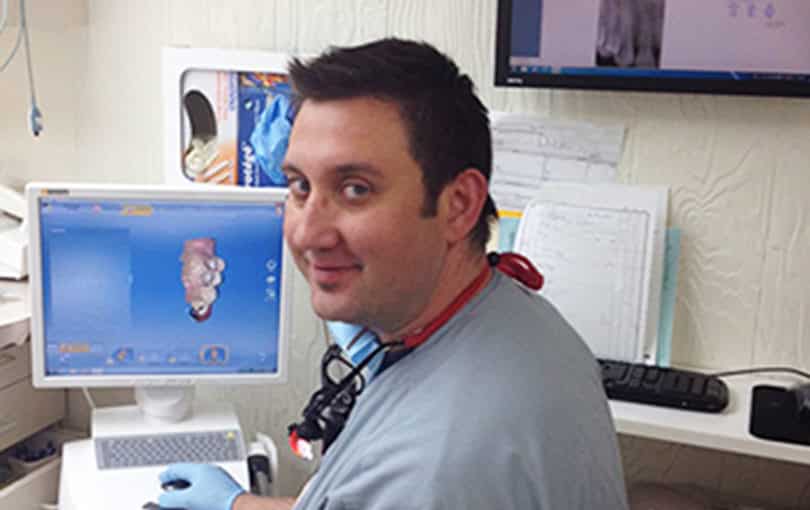
This new technology is in your neighborhood! Family Dental Care™ offers the availability of tooth-colored fillings and crowns, formed to exact tooth dimensions in a single office visit. The new approach to tooth restoration is made possible by innovative CEREC® CAD/CAM technology that designs and mills a custom ceramic restoration in less than 10 minutes. It means that in just 2 hours you can have a crown! There are no temporaries and no need for a second visit. It’s a precise fit.
No unpleasant impression material
Say goodbye to biting on impression material for several minutes, having a numb mouth and jaw ache. Your dentist now has a camera that can do this for you in seconds and then transfer this to the computer.
No bothersome temporary crown
Temporary crowns are exactly what the name suggests: temporary. With CEREC®the final crown is inserted directly without any temporary compromises needed.
No follow-up appointment in most instances
CEREC® enables your dentist to insert esthetic ceramic crowns or partial crowns in a single session.
The advantage of this is that only one appointment is necessary, which means only one injection, and then you can deal with other things than visits to the dentist.
Long-term stability
More than just a theory: With CEREC® you can rely on quality that has been proven millions of times over in the practice. Furthermore, thanks to your new dental crown made by CEREC®, your smile will be just as lovely many years later as it is directly after receiving the crown.
Like a real tooth
Due to the translucency of ceramics, the dental crown looks like a real tooth.
In a ceramic dental crown, no dark edges are visible as is so often the case in conventional crowns.
Ceramic is very close to the hardness of the natural tooth, thus preventing wear of the tooth, which unfortunately so often occurs with other materials.
Ceramic is very well tolerated so allergic reactions are largely excluded. This is not the case with other methods and materials.
The CEREC® method is a gentle treatment for your teeth. Only the decayed tooth surface is removed. The remaining healthy tooth substance is preserved.
All-ceramic fillings
The esthetic alternative to gold, amalgam, and tooth-colored fillings.
Before and After (shown above)
All-ceramic crowns
The most esthetic solution for treating severely destroyed individual teeth.
Before and After (shown above)
Conventional metal crowns are associated with other disadvantages than just inferior esthetic appearance. Gum irritation and impairment of taste or other sensations occur very frequently.
All-ceramic crowns not only allow the perfect restoration of individual teeth, they also give you renewed self-confidence.
All-ceramic veneers
The most esthetic solution for chipped or discolored anterior teeth.
Before and After (shown above)
All-ceramic veneers are ultra-thin, highly esthetic veneers that are placed directly onto the visible surfaces of natural teeth, mainly at the front of the mouth.
Optically, no difference can be detected between all-ceramic veneers and the adjacent natural teeth. You’ll see: Your entire appearance will improve dramatically.
Family Dental Care™, located at 2803 W. 95th Street in Evergreen Park (across from Little Company of Mary Hospital), staffs experienced and certified CEREC® dentists. For immediate assistance and more information, contact them at (708) 425-1134. Weekend and evening appointments are available for your convenience. The website for Family Dental Care™ iswww.FamilyDentalCare.com
Chicago, IL – August 31, 2015 – The condition you may refer to as “gum disease” is also called periodontal disease. The American Dental Association defines periodontal disease as the inflammation of the gums that if severe, can led to the loss of the tissue that hold your teeth in place. Periodontal disease if the…
3D dental technology, otherwise known as “cone beam,’ is available in the south suburbs! Family Dental Care™, located at 9101 S. Cicero Avenue is Oak Lawn has invested in this technology to enhance the quality of care provided for patients.
Technological advances, such as digital imaging systems, have significantly increased the level of detailed information available to dentists while reducing the level of patient radiation exposure. While oral health professionals have long relied on 2-D imaging for diagnosis and treatment planning, this technology typically requires multiple exposures, and with them, multiple doses of radiation.
With cone beam computed tomography (CBCT), oral health professionals gain a highly accurate 3-D image of the patient’s anatomy from a single scan. These 3-D images allow the dentist to better diagnose and understand the true extent of dental disease, and they can provide for more appropriate and faster treatment for patients.
Digital imaging has become one of the most important diagnostic tools for oral health professionals, and the greatest advance in the past decade has come with CBCT. It uses a cone-shaped beam and digital processing to reconstruct a virtually distortion-free 3-D image of the patient’s complete skull or dental anatomy in a single pass, depending on the field of view.
Here are reasons why patient should be aware of this new technology.
Safer Examinations
The CS 8100 3D uses dental 3D technology to limit radiation dose and ensure safer exams.
Confine radiation to area of interest with flexible fields of view
Control size, resolution, and dose for each exam
Adherence to the ALARA Principle helps you keep radiation exposure as low as reasonably achievable
Low dose modes available for 3D images at a lower dose than panoramic images
Convenient for Everyone
This 3D technology makes image acquisition quick and simple.
Intuitive interface and letter landmarks on the bite block simplify the examination process
Open, face-to-face design puts patients at ease and promotes comfort
Fast scanning times (7 seconds minimum) prevent movement and reduce retakes
Accessible to patients of all sizes and individuals in wheelchairs
Versatile Capabilities
From traditional panoramic exams to endodontics, implant planning, oral surgeries and orthodontic applications, the CS 8100 3D is capable of much more than the average 3D unit.
Award-winning 2D technology for superb panoramic images in seconds
Accurate 3D representations ensure accurate diagnoses
CAD/CAM abilities allow a dentist to perform more procedures in their office
Family Dental Care™, located at 9101 S. Cicero Avenue in Oak Lawn has invested in this state-ofthe- art technology and is available Monday through Saturday to consult patients. For immediateassistance and more information, contact them at (708) 425-9101. Weekend and evening appointments are available for your convenience. The website for Family Dental Care™ is www.FamilyDentalCare.com
Esthetic ceramic crowns or partial crowns in a single visit. Ask Family Dental Care™ about CEREC®. This new technology is in your neighborhood! Family Dental Care™ offers the availability of tooth-colored fillings and crowns, formed to exact tooth dimensions in a single office visit. The new approach to tooth restoration is made possible by innovative…
At first, having orthodontic treatment may take a little getting used to. It isn’t uncommon to experience a bit of soreness when appliances are first put on, or some minor aches as teeth begin moving into new positions. Yet it’s comforting to know that genuine orthodontic emergencies are rare.
If you think you may have an emergency, however, the first step is to determine the severity of the problem: Is it an urgent situation that requires immediate attention, or a minor problem that you can take care of yourself, temporarily, until you can come into the office?
A Major Emergency
There are only a few true orthodontic (or dental) emergencies. They include:
Trauma or injury to the teeth, face or mouth
Infection or swelling of the gums, mouth or face
Severe, unmanageable discomfort or pain in these areas
In any of these situations, you should seek help as soon as possible — go to an emergency room, if that’s your best option. Generally, however, the place to start is at the dental office. If, for example, you have a fractured tooth, that immediate problem requires diagnosis and treatment. Afterwards your orthodontic treatment plan can be adjusted as needed. Likewise, severe pain or swelling could be a sign of infection or disease, which also needs immediate treatment.
Some Minor Troubles
Fortunately, the vast majority of orthodontic problems are minor compared to these situations — but they may still cause discomfort or irritation. In general, it’s best to try and soothe the immediate cause of the discomfort and then call for an appointment. Here are a few of the more common orthodontic problems, along with some tips on what you can do to relieve them at home:
Loose or broken brackets, bands or wires
This problem is often caused by eating hard or sticky candy or food, or playing with the braces. If the band or bracket is still attached to the wire, leave it as is — but don’t connect any elastics to it! You can cover it with orthodontic wax if it’s irritating the inside of your mouth. If it has come off, save it. In either case, call our office to let us know what happened, and we will recommend the next step.
Misplaced or poking archwire, bracket or tie
As the teeth start to move, the wire that connects them (archwire) may begin poking near the back of the mouth or irritating the cheeks. You can try moving the wire into a better position with a pencil eraser or a Q-Tip. If the wire won’t move, you may be able to cut the end off with a nail clipper sterilized in alcohol — but before doing so, please call for guidance or instructions. Often, you can also use tweezers to gently move a misplaced wire or a tie that’s causing problems.
When wires or brackets cause irritation, covering the metal parts with wax will often help ease the discomfort. As with any of these types of problems, it’s best to make an appointment so it can be taken care of.
General tooth pain or loosening
It’s normal for teeth to become slightly loosened during orthodontic treatment — that shows they’re moving! Sometimes, this movement may be accompanied by tenderness, especially after braces are placed or adjusted. For minor soreness, you can use your regular over-the-counter pain reliever. A twice-a-day salt-water rinse may also help: Mix one teaspoon of salt in an 8-ounce glass of warm water, and rinse for 30 seconds. A warm washcloth or heating pad placed on the outside of the jaw can also offer some relief.
While actual emergencies are rare, the goal is to make orthodontic treatment as comfortable as possible.
3D dental technology, otherwise known as “cone beam,’ is available in the south suburbs! Family Dental Care™, located at 9101 S. Cicero Avenue is Oak Lawn has invested in this technology to enhance the quality of care provided for patients. Technological advances, such as digital imaging systems, have significantly increased the level of detailed information…